Thursday, January 27, 2011

DAF #37 - Alice in Wonderland (1951)

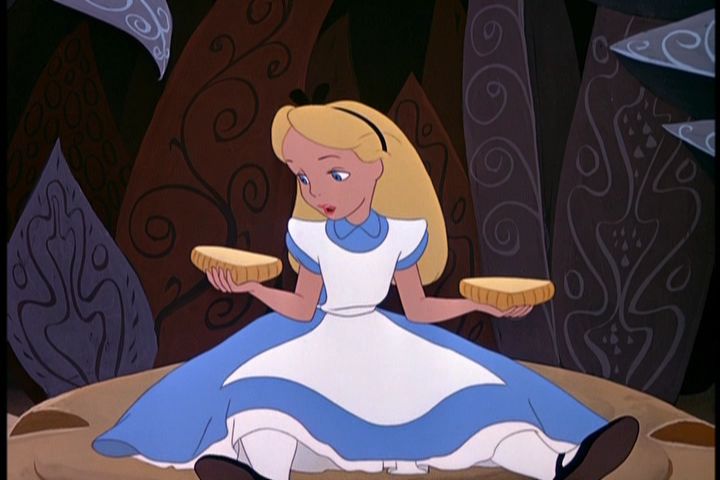
Alice: "But that's nonsense. Flowers can't talk."
Rose: "But of course we can talk my dear."
Orchid: "If there's anyone around worth talking to."
Daisy: "Or about!"


Title: Alice in Wonderland
Year: 1951
Rated: G
Run Time: 1 hour, 15 minutes

Starring
Kathryn Beaumont as Alice
Sterling Holloway as Cheshire Cat
Bill Thompson as White Rabbit/The Dodo
Ed Wynn as The Mad Hatter
Jerry Colonna as The March Hare
Richard Haydn as The Caterpillar
Verna Felton as Queen of Hearts
J. Pat O'Malley as Tweedledum/Tweedledee 

Plot: A young girl follows a rabbit into the magical, nonsensical world of Wonderland.
Based on: Alice's Adventures in Wonderland and Through the Looking-Glass by Lewis Carroll.
Setting: Wonderland, 1860's.

Tagline: The all-cartoon Musical Wonderfilm!

First Viewing:
Early 90's on VHS.

Comments
Fun fact: my middle name is Alice. Therefore, I've always had an odd connection and camaraderie to Alice in Wonderland. (After all, there is simply a lack of female characters named Jordyn...or more likely, Jordan). So, Alices were the next best thing. And being a fan of Peter Pan and The Wizard of Oz as a small child, the third in this triumvirate of "girl gets transported to magical world" stories was a necessity. All that being said, it's my least favorite of the three.

(Anime fan drawing I jacked from DeviantART)
To be fair, I've never read Alice's Adventures in Wonderland or Alice Through the Looking-Glass. I've only seen this Disney version (and the live action Return to Oz-esque sequel with Johnny Depp) and from everything I've researched, neither are the best adaptation. But with both, I can't help but feel that something is missing.

It all begins on the bank of some tranquil river in the English countryside. Young Alice (who appears to be ten in this version) is listening to her sister read a dreadfully dull history book. After being reprimanded, Alice decides she'd rather live in a world of nonsense. Just then, she sees the perpetually late White Rabbit and follows him down a rabbit hole.


Technically, I could summarize as I usually do, but Alice in Wonderland is such an erratic, free-for-all, plotless mindfuck that it would just be easier to do this: Alice shrinks, grows, shrinks, cries, enters a caucus race (whatever the fuck that is), meets the Tweedles, grows, shrinks, sings with some flowers, meets the Caterpillar, meets the Cheshire Cat, meets the Mad Hatter & Co., cries, meets some playing card soldiers, plays croquet with the Queen of Hearts, stands trial for...something, grows, shrinks, and then wakes up discovering it was all a dream.


The Alice books are considered classics of English literature, but I can't help but wonder WHAT'S THE FUCKING POINT??? Peter Pan deals with the freedom of youth vs. the responsibility of adulthood. And the theme of The Wizard of Oz, au contraire to popular belief, is NOT "there's no place like home", it's that the power to succeed is inside you. (Think about it, Dorothy has the shoes all along, The Scarecrow is hardly dumb, the Tin Man is hardly an unfeeling douchebag, and the Cowardly Lion acts with courage many times. This is even apparent in the 1939 musical version! But I digress...)

So I ask again: WHAT IS THE FUCKING POINT OF ALICE IN WONDERLAND???

Well, I've often struggled with assigning a theme to a piece of fiction ever since high school, so I cheated and went to Sparknotes. They say that Alice's constant growing and shrinking are representative of the pubertal changes soon to come in her life. And the Caterpillar is sometimes seen as a symbol of sexual virility, a threatening and befuddling phallus that will FUCK HER SHIT UP!

Beware Alice! He's about to spell "orgasm"!
Also, Life is a confusing and unsolvable puzzle. And I suppose if you squint at Disney's adaptation of AIW, then yeah, sure.

A really big complaint concerning this version is the "lack of heart". I'll voice this complaint as well. Who really gives a shit about Alice? She doesn't have any qualities that make us sympathize with her. She's simply a bored, spoiled English girl who doesn't appreciate history. And then she continually feels sorry for herself after entering a world of her own imagining where "everything is what it isn't". So if there is a moral to Disney's Alice in Wonderland it's be careful what you wish for.

 
Alice in Wonderland did not do to well at box office until the late 60's when our good old friend Narcotics made it a classic. Honestly, I don't have a vendetta against the drug culture that made a few of these DAF's financially successful. After all, I love "White Rabbit" by Jefferson Airplane.

Remember what the Dormouse said: "Feed your head."
I think what it boils down to is that Alice in Wonderland is a story I want to like as much as Peter Pan and The Wizard of Oz, but I just can't! So far there hasn't been an adaptation that's captivated me like with the other two. I was hopeful with Tim Burton's version, but I found it lacking. However, I won't lose hope. Being in the public domain, there is sure to be a satisfying version of Alice in Wonderland made in the future. Honestly, I hope it's an adaptation of American McGee's Alice.


Songs
"Alice in Wonderland" - Chorus
"In a World of My Own" - Kathryn Beaumont (Alice)
"I'm Late" - The White Rabbit (Bill Thompson)
"The Sailor's Hornpipe" - The Dodo (Bill Thompson)
"The Caucus Race" - The Dodo and Animals
"How Do You Do and Shake Hands" - Tweedle Dee and Tweedle Dum (J. Pat O'Malley)
"The Walrus and the Carpenter" - Tweedle Dee and Tweedle Dum
"Old Father William" - Tweedle Dee and Tweedle Dum
"Smoke the Blighter Out" - The Dodo and The White Rabbit
"All in the Golden Afternoon" - The Flowers and Alice
"A-E-I-O-U" - The Caterpillar (Richard Haydn)
"'Twas Brillig" - The Cheshire Cat (Sterling Holloway)
"The Unbirthday Song" - The Mad Hatter (Ed Wynn), The March Hare (Jerry Colonna), and Alice
"Very Good Advice" - Alice
"Painting the Roses Red" - The Playing Cards  (The Melloman) and Alice
"Who's Been Painting My Roses Red?" (Reprise) - The Queen of Hearts  (Verna Felton) and The Playing Cards
"The Unbirthday Song" (Reprise) - The Mad Hatter, The March Hare, The Queen of Hearts, and The Playing Cards
"The Caucus Race" (Reprise) - Chorus
"Alice in Wonderland" (Reprise) - Chorus

Favorite Song: “All in the Golden Afternoon” - Chorus
Favorite Moment: "The Walrus and the Carpenter" segment.
Favorite Character: The King of Hearts

Hooray!
Next DAF: The Sword in the Stone (1963)

Wednesday, January 26, 2011

Sparks Fly...and Eyes Roll : Jordyn vs. Nicholas Sparks

In the time between high school and now, I have come to loathe Nicholas Sparks. LOATHE. And because of this, my dear, dear "friend" Andrew has challenged me to watch all six Nicholas Sparks film adaptations. I have seen two (A Walk to Remember and The Notebook) but the rest I've successfully avoided...until now. In each loving review, I will express exactly why I dislike Nicholas Sparks' certain what the French and hormone addled youth call...I don't know what.


Here's a little known fact in my internet life: once upon a time, I wanted to become a historical romance novelist. Yes, picture in your mind one of those drugstore staples, where Fabio or Sergio or some other mononym male model, with his perfectly sculpted tan chest and flowing golden mullet, embraces a nymph of exceptional beauty who has an equally beautiful chest and head of hair. As he holds her in the rippling vise of his biceps, she swoons and an orgasm overtakes her and her neckline threatens to reveal her pert nipples.


Yeah, those.

I happen to like those. And no, I'm not ashamed of my past. In fact, I've learned lots from them...but that's a different story for a different day. The point is, I loved romance novels and while in high school, got piles upon piles of shit for reading such tripe. Still, I went on reading exactly what I wanted.

It was around this time that other people started nosing their way into my reading habits. My best friend Ashley's grandmother suggested a little novel called "The Notebook" by Nicholas Sparks. Even though some grandmothers read romance novels (like my 101 year old one), I knew that Ashley's grandmother was a little bit more prude, so I asked for a synopsis. I was not impressed.

In high school, things just got worse. The girls in my class started reading Nicholas Sparks books and feeling superior to me. With the tragic endings and teenage characters and cancer patients, those books were more important, damn it! What I read was "perverted" due to many a purple prose sex scene. But seriously now, why in the hell would you not want to read about your favorite characters gettin' it on? (Just a mystery of life, I guess).


So anyway, I hate Nicholas Sparks. Almost to a point where I can't really form coherent arguments and I end up sounding like an ignorant chump jealous of his success. (Not that I am or anything). This blog series will hopefully allow me to finally express my merited disdain for this over-hyped author. I will not be discussing acting, directing, music, art direction, costumes, etc. This will solely be a bitchfest about STORY.
 So sit back, grab a tissue box, barf bag, hit of X, bottle of tequila, rosary or whatever it is you may need to get through the next few weeks because I'm telling you, it won't be easy.


Also, because I'm just as evil as my comrade, Andrew, he will be reviewing six of Tyler Perry's Madea movies over at Diversion 2.0.


Note: No, I am not reading the books because I would like to live to see my next birthday. And if you're going to get snarky and say..."Oooh...if you don't read the books, you're not getting the full experience." I say "Bullshit. If it weren't for the movies, the thirteen year old girls of America wouldn't be picking up his paperbacks at Wal-Mart!"

Tuesday, January 4, 2011

DAF #38 - Fantasia 2000 (1999)


Title: Fantasia 2000
Year: 1999 (Ironic)
Rating: G
Run Time: 1 hour, 14 minutes

Plot: A second collection of animated segments set to classical music.
Based on: Original ideas; "The Steadfast Tin Soldier" by Hans Christian Andersen; The Sorcerer's Apprentice; Chapters 6-9 in the Book of Genesis.
Setting: Various; Under the sea; 1930's New York City; Toyland; Yen Sid's lair...again; Flamingos; Biblical times; The Forest.

First Viewing: Early 2000 at the IMAX with my Girl Scout troop.

Comments
Oh boy, I am getting tired of reviewing these segmented movies! Thankfully, this is the second to last we will get to in this blog. And luckily, I've already done Fantasia, so I will be able to compare and contrast to my heart's desire.

Any Disney fan worth their salt knows how much old Walt loved the idea of setting animation to classical music but few know the original plan was for Fantasia was to be an ever evolving film, released every few years with new sections while old ones were rotated out. But, due to Fantasia being a financial flop and the fact that World War II sucked the European market dry, Disney had to concentrate on other projects. It wasn’t until the early 90’s when Roy E. Disney (Walt’s nephew who appears at the beginning of all those home video release) pushed for his uncle’s dream to be realized.

Originally, "The Nutcracker Suite" (fairies, flowers, and mushrooms), "Dance of the Hours" (ostrich and hippo ballet) and "The Sorcerer’s Apprentice" (Mickey with the wizard's hat) were the only old segments to be included in Fantasia 2000. However, the creative teams were so excited to make new shorts that all but “Apprentice” were cut…lucky for us.

Symphony No. 5, Allegro Con Brio (Ludwig van Beethoven) – Like the original Fantasia, this film starts out suddenly with minor credits and jumps into an abstract piece. Shapes resembling butterflies and bats fight with one another in a world of dark vs. light and good vs. evil. This clash of positive and negative forces is shown through flight in a darkened sky as light is emitted in splashes, rays, and shafts. Obviously, this one's "abstractness" is meant to open the film just as the "abstractness" of "Toccata and Fugue" did back in 1940.


The Pines of Rome (Ottorino Respighi) – A family of humpback whales are able to fly due to a supernova (Uh, sure). While frolicking around, a baby whale is separated from his parents and is trapped under an iceberg. He is later freed by his mother and then joins them in flight. This is probably my least favorite. Whales...eh. Plus it has that weird late 90's animation-CGI blend thing going on that never quite looks right.


Rhapsody in Blue (George Gershwin) – So maybe it's not "classical music". If we're going to get technical, the Classical period of music takes places between 1750-1830. Which means most of the pieces used in the Fantasia series are not "classical". Personally, I love this one. This jazzy tune follows four characters throughout a day in Depression era New York City; a construction worker who longs to be a jazz drummer, a man out of work, a neglected poor little rich girl, and a sugar daddy with a domineering wife. All characters are drawn in Al Hirschfeld’s linear style which fits the music perfectly.


The Steadfast Tin Soldier - Piano Concerto No. 2 (Dmitri Shostakovich) – The Steadfast Tin Soldier is an odd fairy tale written by Hans Christian Andersen. It would probably not make a very good full-length feature, but as a short it works very well. A one legged toy soldier falls in love with a ballerina doll who is pursued by an evil Jack-in-the-Box. The villain throws the soldier out the window, sending him on a great odyssey. But the soldier over comes incredible odds and wins the ballerina's heart.This has some kind of weird CGI-cel animation mix making the characters look plasticine. It works though since all the characters are toys.

 
The Carnival of the Animals (Camille Saint-SaĆ«ns) – The shortest segment involves the daily, choreographed routine of a flock of flamingos which is interrupted when one of them introduces a yo-yo to the mix.This one is fun and such a far cry from the original Fantasia. Yes, we see goofy animal antics in "Dance of the Hours" but not like this. Don't get me wrong, it's nothing new. It's pure slapstick and much appreciated.

 
The Sorcerer’s Apprentice (Paul Dukas) – If only one segment from Fantasia would go into the sequel, it would be this one. It's the exact short from the original: Mickey steals the wizard's hat, enchants the brooms, dreams of being master, chops up the brooms, loses control, and is saved by Yen Sid. You've seen it.


Noah’s Ark - Pomp and Circumstance Marches 1,2,3, and 4 (Edward Elgar) – Oh my Christ, I love "Pomp and Circumstance"! It's quite possibly my favorite piece of classical music (if "classical" means instrumental-non-film-score). Because we've just had a Mickey moment, Donald gets his turn in the sun as Noah's assistant. His duties include herding all the animals, two by two, onto the Ark. But in the confusion, he's separated from Daisy and thinks he is the last of his kind. This one is damn cheesy and probably not like any of the old Donald shorts. (It's nothing like Saludos or Caballeros, you can be sure!) But I really, really enjoy its humor and heart.

 
Firebird Suite, 1919 Version (Igor Stravinsky) – This one's the "masterpiece". This one's the beautiful, dramatic, triumphant finale. This is the one meant to make you jizz in your pants and make you jizz again in mere remembrance. A woodland sprite is summoned by a lone elk to bring springtime to the wintered wilderness. But the beauty of the season is destroyed when she accidentally awakens the Firebird in a nearby volcano. With the help of the elk, she reawakens what lies beneath the ashes of the ravaged forest. Yes, it is beautiful but it's painfully obvious why they saved this one for last. I wonder if it was conceptualized as such: "Fuck! We need something MAGNIFICENT to cap this off! Donald Duck's Bible Stories isn't doing it for me!" I do enjoy this one despite all that.


As I was rewatching Fantasia 2000 for this post, I was surprised at how quickly it went by. I was like "Oh shit, here's the Firebird Suite!". This film is a whopping 50 minutes shorter than its predecessor. For fans of the original, I imagine this is unsatisfying, but I think its juuuuuust right. A movie made of shorts should not drag and this one is like a breeze.

That being said, it was the first DAF released after the Disney Renaissance had ended months earlier with Tarzan. Fantasia 2000 was put into production some time after The Lion King roared as victor of animation, when Disney was God and could do no wrong. Roy pushed for his uncle's dream to be realized and everyone just went along with it. Besides, shorts were rarely made anymore so that could be fun, right? No one heeded the warning of Fantasia's initial theatrical failings. It had since become a film classic! It had made thousands of dollars from its VHS release! Surely a successful sequel would follow in its footsteps. However, that was not the case. Something this Extraordinary was too good for regular movie theaters, and thus, Fantasia 2000 became the first animated film ever released in IMAX.

Fantasia 2000 lost money, but that doesn't hinder my enjoyment of it. I like the music. I like the animation and story lines. I like the length (that's what she said). And, damn it, I even like the cheesy Oscar Presenter-like bumpers featuring Steve Martin, Bette Midler, and James Earl Jones. The contemporary, comic subtext makes it easier for me to enjoy. This isn't your grandpa's intense, stuffy "concert feature." During Fantasia 2000, I can relax. While I watch the original, I feel like I'll get my knuckles snapped with a ruler if I doze off during "The Rite of Spring."


From now on in this little ranking retrospective of mine, you'll find I enjoy the following DAF's more than I don't. Fantasia 2000 is the first of these. It's a damn likable movie all the way through (save for the snags of "Pines of Rome" and that damn "Sorcerer's Apprentice"). Just as I feel its precursor is overrated, Fantasia 2000 is underrated.

Songs
“Symphony No. 5” – Ludwig van Beethoven
“Pines of Rome” – Ottorino Respighi
“Rhapsody in Blue” – George Gershwin
“Piano Concerto No. 2” – Dmitri Shostakovich
“Carnival of the Animals” – Camille Saint-Saens
“The Sorcerer’s Apprentice” – Paul Dukas
“Pomp and Circumstance” – Edward William Elgar
“Firebird Suite (1919 Version)” – Igor Fedorvich Stravinsky

Favorite Song: “Pomp and Circumstance” – Edward William Elgar
Favorite Segment: "Rhapsody in Blue"

Favorite Character: The Steadfast Tin Soldier and the Ballerina


Next Film: Alice in Wonderland (1951)

DAF #39 - The Adventures of Ichabod and Mr. Toad (1949)


Title: The Adventures of Ichabod and Mr. Toad
Year: 1949
Rated: G
Run Time: 1 hour, 8 minutes


Starring
Basil Rathbone as Narrator of "The Wind and the Willows"
Bing Crosby as Narrator of "The Legend of Sleepy Hollow"
Eric Blore as J. Thaddeus Toad, Esq.
J. Pat O'Malley as Cyril Proudbottom
Campbell Grant as Angus MacBadger
Claud Allister as Ratty
Colin Campbell as Moley
Oliver Wallace as Mr. Winkie


Plot: A toad with a weakness for manias is accused of stealing a motorcar while a lanky schoolmaster is pursued by a headless horseman.
Based on: "The Wind in the Willows" by Kenneth Grahame and "The Legend of Sleepy Hollow" by Washington Irving.
Setting: English countryside, early 1900's; Sleepy Hollow, New York, post Revolutionary War.


Tagline: Two Tall Tales by the world's top story-tellers in one hilarious All-Cartoon Feature!

First Viewing:
Spring of 2006 on borrowed on VHS from Karen.


Comments
The Adventures of Ichabod and Mr. Toad marks several important turning points. First of all, it was the last of The Package Films. (I know, I know, it's a sad day, is it not?)  Like Fun and Fancy Free, the two segments of I&MT were planned to be their own features. I don't know when exactly production for these two features started, but by the time they were finished, WWII had been over for four years. Animators and money were back at Disney and they were just one year away from releasing their first "single story" feature in 8 years, Cinderella.


Needless to say, the sheer quality of I&MT animation-wise, story-wise...just everything-wise is a vast improvement over every DAF since Bambi. And it was honored for it. Ichabod and Mr. Toad has the proud distinction of being the first DAF to be nominated for and win a Golden Globe. Although the Oscars had been honoring the DAF's from the beginning, the Globes held back until 1949.


And what was the award Disney's 11th animated feature won? Drum roll please....


BEST CINEMATOGRPAHY - COLOR


Yes, cinematography. The Golden Globes only had this category for about six years and I&MT was up against one other movie, On the Town, a Gene Kelly-Frank Sinatra musical.


Yeah, the one with "New York, New York". It's not really important, just a weird fact in the history of Disney, the Golden Globes, and film in general.


As for the third turning point, Ichabod and Mr. Toad marks a shift in my ranking. Up to this point you could categorize my ranking as such:

Movies I Hate
Lilo & Stitch

Movies I'm "Meh" About
The Three Caballeros
Melody Time
Oliver & Company
Saludos Amigos
Dinosaur
Fun and Fancy Free


Movies I Enjoy for One Specific Reason
Chicken Little (Chicken Little as directed by Michael Bay)
Brother Bear (It's pretty)
Make Mine Music (Johnnie Fedora and Alice Bluebonnet)
Fantasia (The Pastoral Symphony)

Ichabod and Mr. Toad is a movie I am decidedly split on. I love, love, love the Mr. Toad segment but Ichabod...not so much. If the whole thing was "The Wind and the Willows", it would assuredly rank higher, but alas it is merely half of the film and I must be fair.


So, while "Bongo" and  "Mickey and the Beanstalk" have nothing in common, an attempt to link our segments today is made. Basil Rathbone notes all the great characters of English literature: King Arthur! Robin Hood! Becky Sharp! Oliver Twist! And yes, even Sherlock Holmes! But truly, the greatest of them all is J. Thaddeus Toad, Esquire. A rather charming, but wastrel of a character who owns Toad Hall, the pride of the riverside. Our hero's friends, the proper Ratty (a water rat), the gentle Moley (a mole) and the uptight Angus MacBadger (guess) are worried about Toad's spending habits and his susceptibility to fads and manias.


Toad's latest obsession is a yellow gypsy cart pulled by a cockney horse named Cyril J. Proudbottom. However, their adventures cause much damage to the surrounding area so Ratty and Moley try to persuade Toad to give up Cyril and the cart. But before he can give it up, a motorcar catches Toad's fancy and he develops a new mania: Motormania.


For his own good, and for the good of Toad Hall, Ratty and Moley lock Toad in his bedroom to keep him from doing anything irrational. Nonetheless, Toad escapes and finds himself accused of stealing a motorcar. In truth, he fairly traded the deed of Toad Hall to one Mr. Winkie (who possesses the most shit-eating-grin in the history of Disney Animation) for his motorcar. But come the trial, Mr. Winkie claims that it was Toad tried to sell a stolen motorcar.


While in jail, Toad begins to realize the errors of his reckless ways. But before he can fully repent, Cyril comes for a visit disguised as Toad's grandmother and helps him escape. Toad eventually finds Ratty and Moley who have since learned of their friend's innocence and that Toad Hall had been taken over by Mr. Winkie and his band of weasels.


He's been eating some shit, I'd say.
With a little help from his friends, Toad regains the deed to Toad Hall and clears his good name. He promises to be through with manias from and his friends toast to a "new Toad". However, all are surprised to see Toad's new mania: airplanes.


While it's quite possible that you've seen "The Wind and the Willows" segment on its own, you could not have gone to an elementary school Halloween party without a routine viewing of Disney's "The Legend of Sleepy Hollow". At the conclusions of Toad's adventures, Bing Crosby takes over the narrating reigns to relate to us his favorite American character: Icahbod Crane, the gangly, greedy, and gluttonous new schoolmaster in the humble hamlet of Sleepy Hollow.


Despite his ridiculous appearance, Ichabod is popular with the ladies, while for the gents, he's an easy target for pranks. Brom Bones (the early model for Beauty and the Beast's Gaston), is the biggest bully of them all. Things get heavy when Ichabod discovers Katrina van Tassel, the most beautiful girl in the land and the daughter of the richest farmer for miles.


Flitatious Katrina views Icky as a means of discouraging Broms (and to make him jealous, if you ask me), but it does nothing but encourage him. Several plans to make Ichabod fall out of favor with Katrina fail until the night of the van Tassel's annual Halloween party. Knowing of Icahbod's proneness to superstitions, Brom tells the tale of The Headless Horseman to show his rival's weakness.

Ichabod rides home alone, exceptionally frightened. The Headless Horseman appears, riding a large black horse similar to Brom's and chases Ichabod across the bridge where the graveyard lies. The Horseman throws a flaming Jack-o-Latern and everything fades to black.

The next day, a shattered pumpkin and Ichabod's hat are found at the bridge. The rumors fly. Some say Ichabod moved to the next county over and married a widow with several children. But other believe he was whisked away by The Headless Horseman. And, of course, Brom and Katrina were wed and the Horseman is never seen again.

The major differences between these two segments is the characters. "The Wind in the Willows"'s are flawed but likable nonetheless: Toad is a wastrel, but he is so passionate and loyal to his friends; Ratty is stuffy, but his moral compass always points north; Moley is naive, but loves his friends in spite of their flaws. However, when it comes to The Legend of Sleepy Hollow, no one is likable: Ichabod is a gold digger and he ain't messin' with no broke...broke...or women who can't cook or can pay for someone to cook; Brom is a ne'er-do-well, gold digging bully; And Katrina is a heartless, blue-balling coquette. 

Also, am I the only one who notices this? Disney women 1945-1950 look identical. Feast your eyes:

1. Grace from Make Mine Music 2. The Golden Harp from Fun and Fancy Free 
3. Slue Foot Sue from Melody Time 4. Katrina van Tassel 5. Cinderella
While Mr. Toad teaches the valuable lesson of sticking by your friends through thick and thin, Ichabod gives us a far less satisfying moral: if you frighten your romantic rival, love shall be yours and brawn over brains always wins. It seems like a tale as old as time, doesn't it? Nerd and jock compete for the cheerleader. Of course, if this were a 80's teen comedy Ichabod would surely prevail. Buts since Icky is such a jerkoff, he doesn't win. Indeed, Brom is the bigger jerkoff and so he ultimately deserves an air-headed cocktease like Katrina. Of course, all this stems from Washington Irving's original short story. One can only surmise as to why the bigger asshole wins the girl.

I don't like that I've dwelled so much on "Sleepy Hollow" when really the shining part of this movie is "Willows". But I guess it's always easier to bitch about the negative than accentuate the positive. While I think Ichabod's section is just as long as it needs to be, it would have been terrific to see a full-length treatment of Mr. Toad's adventure. After all, one is based on a short story while the other on a novel.

The Adventures of Ichabod and Mr. Toad is easily the best package film. In many ways, it's so above and beyond its predecessors, it shouldn't be lumped along with something like Saludos Amigos. But those are the breaks.

Songs

  • “No Where in Particular” - Eric Blore (Toad) and Pat O'Malley (Cyril)
  • "Ichabod" - Bing Crosby
  • "Katrina" - Bing Crosby
  • "The Headless Horseman" - Bing Crosby (Brom Bones)


Favorite Song: “No Where in Particular” - Eric Blore and Pat O'Malley
Favorite Moment: Toad "driving" down the road on his ass.
Favorite Character: Moley...he's so damn cute. Probably the cutest Disney character ever!


Next Film: Fantasia 2000 (1999)

Monday, December 27, 2010

DAF #40 - Fantasia (1940)


Title: Fantasia
Year: 1940
Rating: G
Run Time: 2 hours, 4 minutes

Plot: A collection of animated segments set to classical music.
Based on: Original ideas and interpretations of classical music.
Setting: Nature; Yen Sid's lair; uh, Earth from the dawn of time to 65 million years ago; mythological Greece; Some ballet studio place; Some Slavic village.

Tagline: Walt Disney's Technicolor FEATURE triumph!

First Viewing: Sometime after the first home video release in the early 90's.

Comments
The good news is, we're out of the bottom ten! The bad news is, eleventh from the bottom, just slightly above most of the package films and Chicken Little, is Disney's 3rd animated feature and pet project, Fantasia.


[Pausing for gasps]


How is it possible, you ask? How can I, esteemed amateur Disney-phile film critic that I am, possibly dislike Fantasia? My apologies, but you'll just have to wait until the end of the review before I start defending myself.


A little history before I chew my way through: So Walt had been exceptionally successful with Snow White and the Seven Dwarfs. His second DAF, Pinocchio, for some reason didn't fare too well. None the less, Disney decided to keep making movies HE wanted to see, and by God, HE wanted to see classical music set to surrealistic animation.


Fantasia starts with little fanfare as who-the-hell-is-Deems Taylor introduces this new concept of animation and musical synergy. He explains that several of the pieces have a story while some are just "music for music's sake". Any story that originally went with this music has been pushed to the wayside for Disney and his artists' own interpretation. Let's begin.

Toccata and Fugue in D Minor (Johann Sebastian Bach) – Music for music's sake. It starts with shots of the orchestra and then blends into abstract animation that more or less follows what the music is "doing". There really isn't that much more to it.


Nutcracker Suite (Pyotr Ilyich Tchaikovsky) – I'll give them props on this one. There is nothing to do with nutcrackers, rat kings or Christmas. (Can you imagine how played to death this thing would be in December???) Instead we see a collection of "mini vignettes" of various flora, fauna, and faeries changing the seasons from summer to autumn to winter. We have naked fairies, Chinese mushrooms, sexy fish, Russian thistles and more naked fairies. Probably my second favorite segment.


The Sorcerer's Apprentice (Paul Dukas) – Oh boy, speaking of played to death...Here we have the painfully classic piece where Mickey Mouse, that little scamp, steals his master's magic wizard hat to lighten his seemingly endless chore of carrying buckets of water to a big tub. (Seriously, why? Is it for the wizard's bath or something?) Mickey enchants a broom to do all the heavy lifting and then falls into a dream where he is the undisputed master of OUTER SPACE...and water? When he awakens, the whole place is flooded so he HACKS UP THE BROOM because he can't figure out how to stop it. However, the splinters of the broom form new super brooms that keep filling the tub. FINALLY, the wizard wakes up, fixes everything and gives Mickey a sound smack on the ass.


The Rite of Spring (Igor Stravinsky) – If there is any given reason why I dislike Fantasia so much it is because of this segment. Originally, "The Rite of Spring" was meant to be some kind of "primitive ballet". Disney's take was to show the formation of Earth and its evolution until the extinction of the dinosaurs. And, oh my Christ, I swear the real evolution of the Earth took less time than this segment. (I know my bitchiness is showing). Plus, out of all the music, this piece is my least favorite. It's very harsh and manic and just fucking unpleasant. But truly, my disdain for "The Rite of Spring" comes down to: "I don't like dinosaurs. They're icky." I thought it when I five and I'll think it when I'm 95.


Intermission – Since everyone in the theater now needs a drink, we get a short little interlude where each musical instrument is introduced as well as visual representation of its specific sound. It's mostly pandering, but quite necessary to lighten the mood after "The Rite of Spring".

 
The Pastoral Symphony (Ludwig van Beethoven) – Are you in any way shocked that this is my favorite segment of Fantasia? You shouldn't be. It's the closest to having pretty, pretty princesses. It begins in "mythological Greece" as baby pegasi learn to fly with the aid of their parents. Then the little cherub-faun-satyrs play matchmaker for all the unhitched centaurs. The next day, Bacchus (or Dionysus if you prefer) throws a great celebration with wine, women (well, zebra centaurs), and song which Zeus decides to fuck up with a storm. But, ho ho, it's all just an ordinary day in mythological Greece!


"The Pastoral Symphony" is marred with a bit of controversy. In the original release, a centaurette's grooming was being aided by an African-American centaur named Sunflower, who instead of having a horse body, had a donkey body...and huge lips...and nappy corn rows. Ever since 1969, this racially insensitive image has been cut from the film and the subsequent home video release. None the less, for educational purposes, I give you Sunflower.


However, these chicks stayed:


Dance of the Hours (Amilcare Ponchielli) – Hello Muddah, hello Fadduh, here I am at Camp Granada...if you know that tune, then you know "Dance of the Hours". This is the most humorous and light of all the Fantasia segments. And as much as I love "The Pastoral Symphony" we need something SiLLy at this point in the film! And what, pray tell, is sillier than ostriches, hippos, elephants, and alligators doing ballet? NOTHING. Ha ha ha... is it over yet?


Night on Bald Mountain/Ave Maria (Modest Mussorgsky/Franz Schubert) – The second most famous segment in Fantasia is, without a doubt, "Night on Bald Mountain". This is owed to the over hyped villain, Chernabog, who is based on an evil Slavic demon of little known origin (or importance according to Wikipedia). But in Fantasia he is basically THE DEVIL. Throughout the night, Chernobog summons evil spirits and demons and, uh, plays with them until the morning church bells sound.


I'll be honest with you, as a child, I couldn't watch this part. I'd make it about two minutes in before shutting off the TV. So, I'm not as familiar with this segment as I am with the others. In fact, it wasn't until high school that I learned there was even a second part where all the towns people walk to church with their lanterns to "Ave Maria".


I didn't know about this, either:


RED! NIPPLES!
And now I'm going to bitch about Chernobog. Is he scary? Yes. He's the only animated character to scare me. Is he a superbly animated character? Yes. Is he a villain? FUCK. NO. He doesn't do anything! He summons some spirits, but does he send those spirits to do his evil bidding? NO! He just makes them dance for him. He is not a villain! All he does is look menacing and then fold up come the morning light. OVERRATED! LIKE THIS WHOLE DAMN MOVIE!!!


And here it comes...


Fantasia is overrated. Yes, it is an original concept. Yes, it is the precursor to the music video. Yes, it has good animation and probably good sound mixing. But all that doesn't make up for the fact that it's overlong, pretentious, and survives off its own sense of superiority. The first few DAF's, (Snow White, Pinocchio, Dumbo, and Bambi) all have a certain humility to them. They know they are family films and they know that's okay. But Fantasia, oh boy, Fantasia is for sophisticated adults. Fantasia is a concert feature. Fantasia WOULD CHANGE THE FACE OF CINEMA FOREVER!!!


But, at least at the time of its initial release, it didn't. It was actually a pretty big bomb. And after FIVE rereleases, the damn thing still managed to stay under the radar of the viewing populace. Nobody gave two shits about dancing mushrooms. That is, until 1969. I don't know who exactly was in charge of the Disney corporation at the time (with Walt having died three years earlier), but someone knew that there was counter culture of hippie youth who would take drugs and see "head movies". And that same someone realized that Fantasia was pretty damn psychedelic and there was a pretty good chance that it would usher LSD raddled minds into the theaters. If you think it happened by accident, take a look at this poster.


Yes, I've already posted this in my The Three Caballeros review (to illustrate a similar point), but it bears witnessing again. I mean, look at that thing! It's an acid nightmare waiting to happen. (I wonder how many "bad trips" are owed to "Night on Bald Mountain"). It's because of this drug association that the Disney company finally made money off of Fantasia and from then on, it was heralded as a masterpiece of American animation. Boy howdy, what drugs can do for a movie!*


It's because of this that I'm certain my own father likes Fantasia. It was one of the earliest DAF's we owned, in fact. My dad used to watch it with sound turned off and The Grateful Dead blaring instead of Tchaikovsky and Beethoven. (Take from that what you will). Therefore, I've seen it WAY too many times. I also didn't own that many movies so Fantasia was in heavy rotation.


I know a few people (other than my dad) who really, truly love Fantasia and easily rank it in their top ten. Good for them. If you yourself like it, it's no skin off my teeth. Like a lot of good movies, Fantasia was misunderstood and under appreciated in its time. However, if the Summer of Love never happened there is no doubt in my mind that Fantasia would be categorized with the segmented package films.


And is it really any better than Make Mine Music or Melody Time? Is it really? It's longer and more self important and uses CLASSICAL MUSIC, but does that make it that much better? I certainly don't think so, hence my ranking. Fantasia was underrated at the time of its release, but now its distended into this tour de force, end all be all of animation. In truth, it should probably be ranked somewhere right in the middle, but if someone can put it at their #1, then I can put it at my #40.


Still, maybe with a little herbal influence, I would finally see what all the fuss is about.


I can SEE the MUSIC!
Songs
“Toccata and Fugue in D Minor” – Johann Sebastian Bach
“Nutcracker Suite” – Pyotr Ilyich Tchaikovsky
“The Sorcerer's Apprentice” – Paul Dukas
“The Rite of Spring” – Igor Stravinsky
“The Pastoral Symphony” – Ludwig van Beethoven
“Dance of the Hours” – Amilcare Ponchielli
“Night on Bald Mountain” – Modest Mussorgsky
“Ave Maria” – Franz Schubert


Favorite Song: "Ave Maria"
Favorite Segment: "The Pastoral Symphony"
Favorite Character: The littlest mushroom kind of looks like a willie...am I the only who sees this? He gets the biggest laugh, and therefore, is my favorite.


Next Film: The Adventures of Ichabod and Mr. Toad (1949)


*Seriously, I hope there is some mention on the new Blu-ray of this poster and how psychedelia had a lot to do with this flick's resurgence into the mainstream. But I wouldn't be surprised if it was glossed over. (Let me know, Andrew!)